Category: LEARN ROBOTICS

AUTOMATED GUIDED VEHICLE – 21012

An automated guided vehicle (AGV) is a robot cart that runs without a driver. The cart has an electric engine and is guided by a magnetic field, produced by a wire on or just beneath the floor. Alternatively, an AGV can run on a set of rails. In automated systems, AGVs are used to bring components to assembly lines. AGVs can also serve as attendants in hospitals, bringing food and nonessential items to patients, or as mechanical gophers to perform routine chores around the home or office.
ATTRACTION GRIPPER (MAGNETIC GRIPPER) – 21011

An attraction gripper is a robot end effector that grasps objects by means of electrical or magnetic attraction. Generally, magnets are used; either permanent magnets or electromagnets will serve the purpose. Electromagnets offer the advantage of being on/off controllable, so an object can be conveniently released without its having to be secured by some external means. Permanent magnets, conversely, offer the advantage of a minimal maintenance requirement.

ASIMOV’S THREE LAWS – 21010

In one of his early science-fiction stories, the prolific writer Isaac Asimov first mentioned the word “robotics,” along with three fundamental rules that all robots had to obey. The rules, now called Asimov’s three laws, are as follows.

• A robot must not injure, or allow the injury of, any human being.
• A robot must obey all orders from humans, except orders that would contradict the First Law.
• A robot must protect itself, except when to do so would contradict the First Law or the Second Law.

Artificial Intelligence of Robots – 21009

Artificial intelligence is difficult to quantify; the most tempting standard is to compare “machine intelligence”with human intelligence. For example, a smart machine can be given an intelligence quotient (IQ) test similar to the tests designed to measure human intelligence. In this interpretation, the level of AI increases as a robot or computer becomes more “human-like” in its reactions to the world around it. Another scheme involves the use of games requiring look-ahead strategy, such as checkers or chess.

ARTICULATED GEOMETRY – 21008

Robot arms can move in various different ways. Some can attain only certain discrete, or definite, positions, and cannot stop at any intermediate position. Others can move in smooth, sweeping motions, and are capable of reaching to any point within a certain region.

ANTHROPOMORPHISM – 21007

Sometimes, machines or other objects have characteristics that seem human-like to us. This is especially true of advanced computers and robots.We commit anthropomorphism when we think of a computer or robot as human. Androids, for example, are easy to anthropomorphize. Sciencefiction movies and novels often make use of anthropomorphisms.

Android – 21006

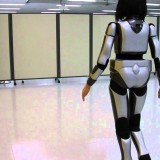
An android is a robot that has human form. A typical android has a rotatable head equipped with position sensors. Binocular machine vision allows the android to perceive depth, thereby locating objects anywhere within a large room. Speech recognition and speech synthesis can be included as well. Because of their quasi-human appearance, androids are especially suited for use where there are children.

Amusement Robot – 21005

An amusement robot is a hobby robot intended for entertainment or gaming. Companies sometimes use them to show off new products and to attract customers. They are common at trade fairs, especially in Japan.Although they are usually small in size, they often have sophisticated controllers.

Adhesion Gripper for Robotic Arms – 21004

An adhesion gripper is a robot end effector that grasps objects by literally sticking to them. In its most primitive form, this type of gripper consists of a rod, sphere, or other solid object covered with two-sided tape. Velcro™ can also be used if the object(s) to be grasped are likewise equipped.

A major asset of the adhesive gripper is the fact that it is simple. As long as the adhesive keeps its “stickiness,” it will continue to function without maintenance. However, there are certain limitations. The most significant is the fact that the adhesive cannot readily be disabled in order to release the grasp on an object. Some other means, such as devices that lock the gripped object into place,must be used.

ADAPTIVE SUSPENSION VEHICLE Robot (ASV) – 21003

An adaptive suspension vehicle (ASV) is a specialized robot that uses mechanical limbs to propel itself. It moves on several legs like a gigantic insect. This provides excellent stability and maneuverability. The ASV can carry several hundred kilograms, and moves at 2 to 4 m/s. The machine itself masses 2 to 3 metric tons. It is the size of a small truck, and it can carry a driver or rider.

The design and construction of a robot with legs is considerably more difficult than that of a wheel-driven or track-driven robot, but there is a payoff: the ASV can move over much rougher terrain than any vehicle with wheels or a tack drive.