Robotic Mechanisms – FACE Gears – 51039
Face gears are the gear wheel with cogs mortised into its face, usually in conjugation with a lantern pinion.

World's Largest Robot Resource
Face gears are the gear wheel with cogs mortised into its face, usually in conjugation with a lantern pinion.
Worm gears resemble screws. A worm gear is usually meshed with a spur gear or a helical gear, which is called the gear, wheel, or worm wheel.
Double helical gears, or herringbone gears, overcome the problem of axial thrust presented by “single” helical gears, by having two sets of teeth that are set in a V shape.
Helical or “dry fixed” gears offer a refinement over spur gears. The leading edges of the teeth are not parallel to the axis of rotation, but are set at an angle. Since the gear is curved, this angling causes the tooth shape to be a segment of a helix.
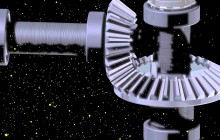
This class of gears includes the most common straight and spiral bevel gears as well as miter and hypoid gears.
• External Gears have teeth on the outside surface of the disk or wheel.
• Internal or Annual Gears have teeth on the inside surface of a cylinder.
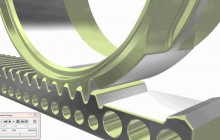
Rack Gears Defined: a bar or rectangular gear (flat, no curvature) having straight teeth cut on the face, perpendicular to the axis of motion.
Internal Gears usually drive or are driven by a pinion. Internal gears are spur gears turned “inside out.” In other words, the teeth are cut into the inside diameter while the outside diameter is kept smooth.
Spur gears or straight-cut gears are the simplest type of gear. They consist of a cylinder or disk with the teeth projecting radially, and although they are not straight-sided in form, the edge of each tooth is straight and aligned parallel to the axis of rotation.
A gear is a wheel with evenly sized and spaced teeth machined or formed around its perimeter.
22 Apr, 2015
10 Feb, 2015

Robotic MECHANISMS – SCREW SYSTEMS 51007
30 Dec, 2014
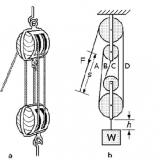
Robotic MECHANISMS – PULLEY SYSTEMS 51005
30 Dec, 2014
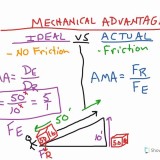
Efficiency of Machines & Mechanical Advantage 51006
30 Dec, 2014
30 Jan, 2015


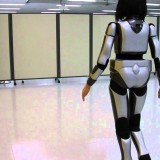
Humanoid Robot Walking Like A Real Human – 11004
24 Jan, 2013